
The Importance of On-Country Learning - Puli Blue Ankunytja (Going to the Blue Rock)

On Wednesday the 15th of May 2024, Nyangatjatjara students from Imanpa campus participated in an ‘On Country’ learning activity to ‘Puli-Blue’, Imanpa Community, Northern Territory. ‘Puli Blue’ is a short 3.8km drive from Imanpa Community on unsealed roads, and is a location of cultural significance for the Anangu people of Imanpa Community. It is located: https://maps.app.goo.gl/9VJVr1HyuvuYZdGdA
The process of establishing a suitable location for the On Country learning activities were developed firstly through early consultations with Community Elders including Gary Mumu and David and Lilian Inkamala. To begin the process, an initial site-visit was arranged on the 7th of May 2024 with Gary Mumu. Gary shared historical stories of ‘Puli Blue’, identified local bush foods, and gave permission for Nyangatjatjara College to facilitate On Country activities at this location.
Following this initial consultation, I did another site visit with David Inkamala on the 9th of May 2024. We walked up the ravine to assess how far up the water was, and to find out if it was possible for the Early Years and Primary students to safely do this trek. From this hike, we’ve identified that water was too far up to walk to on foot and that instead students would need to do activities at base of the ravine.
David expressed that he was happy to talk with students at the base of the ravine about his memories of the place as a little child and the dream-time story of ‘Wanampi’ (The Rainbow Serpent) sleeping in the top waterhole, carving the ravine, and bringing down the water. He also explained there are remnants of old Wiltja’s nearby that could be talked about and how the old people used to camp there for water before travelling on. This visit was important for developing a clear risk-assessment and curriculum plan for suitable On Country learning activities for the students.

After these initial community consultations, on Wednesday the 15th of May 2024, Imanpa students were part of the first On-Country Bush-Trip of the Year. Before setting off on the On Country Bush Trip, students were given an overview of the learning activities for the day, and a presentation of the connections between Ranger work and On Country learnings. Students learnt that the days activities were considered a career training opportunity for future Ranger work. Students were shown the ‘Little Ranger Awards’ that would be presented to good listeners and learners.The students were supervised by Nyangatjatjara College staff along with Adelaide Church from Tangetyere Council and Anangu Community members David Inkamala and Kevin and Elizabeth Wilson.

After the day plan was shared with 16 little Rangers from School, and with four fully loaded vehicles, we headed out to ‘Puli Blue’ (Imanpa Blue Rock). Nyangatjatjara students were very happy to be heading out onto Country!
On our slow walk down to ‘Puli Blue’ Kevin & Elizabeth Wilson along with David Inkamala taught students about the bush food ‘Arnguli’ (Bush Plum - Tantalum Lanceolatum) and the bush medicine plant ‘Wakalpuka’ (Dead Finish Bush - Acacia Tetragonophylla)

Kevin taught students about how sharp quartz pieces were used historically by ancestors by attaching them onto spear-throwers with kangaroo tendons and spinifex resin glue and. Kevin also taught students to identify animals by their droppings. David taught students how to identify native animals by their tjina (tracks).
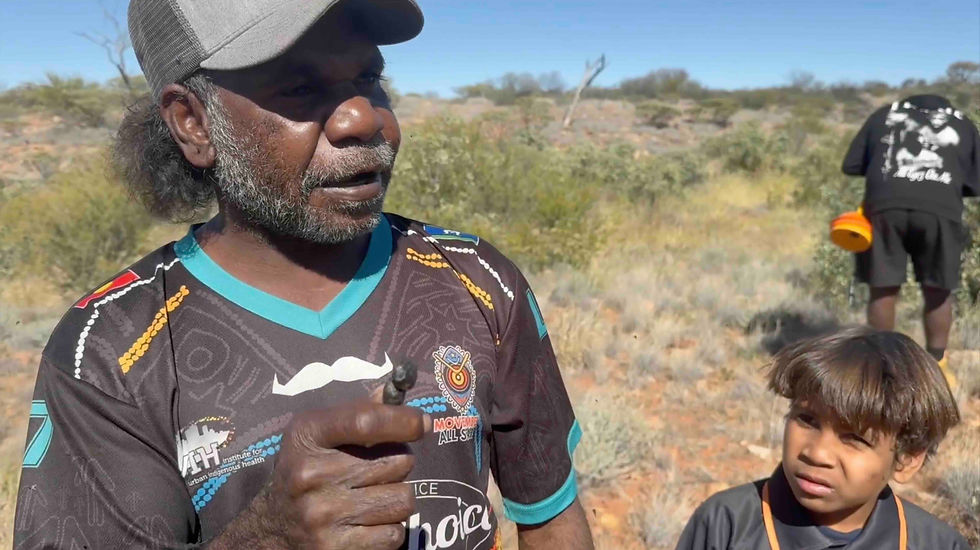
At the base of the ravine of ‘Puli Blue’, the students participated in rotating activities with David, Kevin, and Elizabeth. Students had the opportunity to learn the Pitjantjatjara names of native animals by playing flash-card activities, learn traditional knowledge teachings connected with fauna and flora, and also the history of ‘Puli Blue’ and it’s cultural significance to Anangu people.The community support and willingness to share was excellent, and despite the challenges of many flies, the students were engaged and behaved well.

The documenting of the activities throughout the day has also proved to be an important source of rich learning material which has been translated into the book ‘Puli Blue Ankunytja’ (Bush Trip to Blue Hill) developed by Adelaide Church of Tangentyere Council.

The Puli Blue On Country learning activity was a valuable experience for all the staff and students involved, and is helping to facilitate a stronger two-way learning model. The integration of Pitjantjatjara language learning along with two-way Science, History, and developing an understanding of aspects of Anangu Ranger work, has been excellent.
The On Country Puli Blue activity is recognised as an important and meaningful event which continues to offer staff and students opportunities for meaningful two-way learning.


Comments